What a Chargeback Reason Code Tells You
A chargeback reason code is the label the card issuer attaches to a dispute to say why the cardholder wants the money back. Visa uses numbered dispute conditions such as 10.4 or 13.1, and Mastercard uses message reason codes such as 4837 or 4853. The code decides which rules apply and which evidence can win.
This page is a reference list for Visa and Mastercard. For how a dispute moves from the issuer to you and the deadlines on each side, see what is a chargeback. For how to build and write the response, see how to win a chargeback. American Express and Discover use their own code sets, which this guide doesn't cover.
How to read a Visa code and a Mastercard code
A Visa code has two parts. The digits before the dot are the dispute category, and the digit after it is the condition inside that category. So 10.4 sits in category 10, Fraud, and 13.1 sits in category 13, Consumer Disputes. The current edition of the Visa Core Rules and Visa Product and Service Rules is dated 18 April 2026, and it has no condition numbered 12.1, so the Processing Errors list starts at 12.2.
A Mastercard code is a four-digit number. Mastercard's Chargeback Guide lists most codes as a pair, such as 4837/37, where the two-digit form is the one used on its Single Message System. That is why people search for "chargeback reason code 37" or "reason code 53": those are 4837 and 4853 in their short form.
Chargeback reason codes are not decline codes
A decline code comes back in the authorization response, in seconds, before any money moves. A chargeback reason code arrives after a sale settled, when the cardholder's bank pulls the money back. If you need the authorization side, see our list of credit card decline codes. The two do meet in one place: completing a sale after a decline can itself lead to a chargeback under Visa 11.2.
Visa Chargeback Reason Codes (Dispute Conditions)
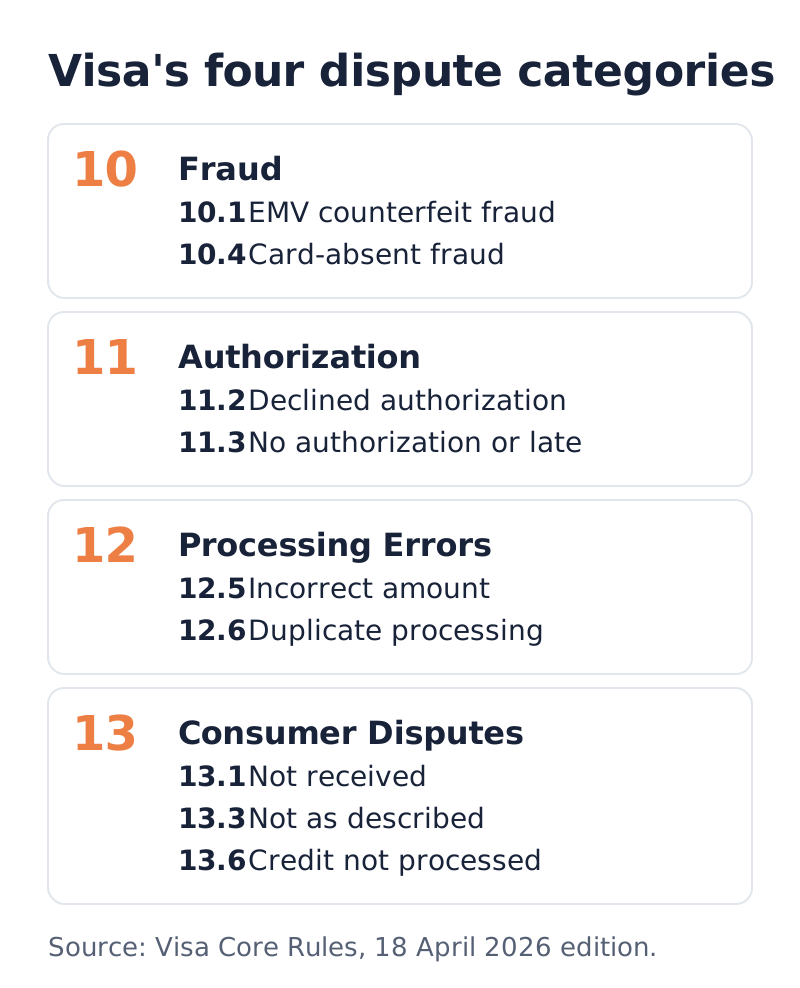
The names below are Visa's own. The "what to send" column is a summary of the evidence Visa's rules accept in a response. Nearly every condition also accepts proof that you already issued a credit or reversal the issuer didn't account for, or proof that the dispute is invalid, so those aren't repeated on each row.
Category 10: Fraud (10.1 to 10.5)
| Code and Visa name | What it means | What to send |
| 10.1 EMV Liability Shift Counterfeit Fraud | A counterfeit chip card was used in person and the chip wasn't read, or full chip data wasn't sent | Evidence the dispute is invalid, such as a chip read with full chip data sent |
| 10.2 EMV Liability Shift – Non-Counterfeit Fraud | In-person fraud on a PIN-preferring chip card at a terminal that couldn't read the chip or wasn't EMV PIN-compliant | Evidence the dispute is invalid, such as a chip read at an EMV PIN-compliant device |
| 10.3 Other Fraud – Card-Present Environment | The cardholder denies a key-entered sale made in person | Evidence of an imprint |
| 10.4 Other Fraud – Card-Absent Environment | The cardholder denies an online, phone or mail order | Visa Secure authentication data, or compelling evidence such as 2 earlier undisputed orders with matching data |
| 10.5 Visa Fraud Monitoring Program | Visa told the issuer the sale was flagged by its fraud monitoring program | Only a credit already issued or proof the dispute is invalid |
To prevent fraud codes: dip or tap chip cards instead of keying them, and run card-not-present orders through 3-D Secure (Visa Secure). See card-not-present transactions.
Reason code 10.4: card-absent fraud
Visa 10.4 applies when the cardholder "denies authorization of or participation in" a card-absent sale, and the issuer has 120 calendar days from the Transaction Processing Date to file it. Visa's rules make a 10.4 dispute invalid in several cases a merchant controls:
- Visa Secure authentication. A sale authenticated through EMV 3-D Secure and sent with ECI 5 and the CAVV is protected. So is an attempted authentication (ECI 6 with a CAVV), except on non-reloadable prepaid cards.
- CVV2 mismatch approved anyway. You sent the CVV2, the result was N (no match), and the issuer approved anyway.
- Two earlier undisputed orders. The card was used in 2 earlier transactions not reported as fraud, processed more than 120 and no more than 365 days before the dispute, and the IP address or device ID/fingerprint, plus one more element such as the login ID or full delivery address, match the disputed order. You also need a detailed description of each purchase. From 24 October 2026, the 2 earlier transactions may be at one or more merchants.
- AVS U on a US domestic sale. You attempted Address Verification and got result code U, with exceptions for commercial and non-reloadable prepaid cards. See our AVS mismatch guide.
Category 11: Authorization (11.1 to 11.3)
| Code and Visa name | What it means | What to send |
| 11.1 Card Recovery Bulletin | A sale under your floor limit, with no authorization, on a card listed in Visa's Card Recovery Bulletin | For hotels, car rental and cruise lines, proof the card wasn't listed on the check-in, rental or embarkation date |
| 11.2 Declined Authorization | You completed the sale after a decline or pickup response | Proof of an offline chip approval, or all approved authorizations for a hotel, car rental or cruise stay |
| 11.3 No Authorization/Late Presentment | No valid approval, or the sale was processed outside Visa's timeframe | A receipt whose date proves timely presentment and an approval; estimated and incremental authorization records |
To prevent authorization codes: never force a declined sale through, get an approval on every sale, and settle your batch on time. See our authorization hold guide for capture windows.
Category 12: Processing Errors (12.2 to 12.7)
| Code and Visa name | What it means | What to send |
| 12.2 Incorrect Transaction Code | A credit processed as a debit, a debit as a credit, or a refund sent instead of a reversal | The receipt or record proving the transaction code was right |
| 12.3 Incorrect Currency | Wrong currency, or dynamic currency conversion without the cardholder's express agreement | The receipt showing the currency; for DCC, certification you're registered to offer it plus the receipt |
| 12.4 Incorrect Account Number | The sale was processed on the wrong card number | The record proving the correct card was charged |
| 12.5 Incorrect Amount | The amount is wrong, or an addition or transposition error happened | The receipt or record proving the amount was correct |
| 12.6 Duplicate Processing/Paid by Other Means | Same card, same date, same amount processed twice, or the customer paid another way | 2 receipts for 2 separate purchases, or proof you weren't paid by other means |
| 12.7 Invalid Data | The authorization used invalid data, or its MCC doesn't match the clearing record | Proof the authorization data was valid |
To prevent processing errors: void mistakes the same day instead of refunding them, check totals before you tap Charge, and watch for double submissions when a terminal or checkout page times out.
Category 13: Consumer Disputes (13.1 to 13.9)
| Code and Visa name | What it means | What to send |
| 13.1 Merchandise/Services Not Received | The cardholder paid, but you didn't deliver | Proof of delivery showing the full address, a signed pickup record, or proof services were available |
| 13.2 Cancelled Recurring Transaction | You billed a recurring charge after the cardholder withdrew permission or the account closed | Proof of the agreed cancellation date, or that services were used after cancelling |
| 13.3 Not as Described or Defective Merchandise/Services | The item didn't match its description, arrived damaged, or the quality is disputed | Proof it matched the description plus your rebuttal, or proof no return was attempted |
| 13.4 Counterfeit Merchandise | The rights owner, a government agency or a third-party expert identified the goods as counterfeit | Evidence the goods weren't counterfeit |
| 13.5 Misrepresentation | The cardholder says the terms of sale were misrepresented | Proof of the terms; for trials, proof of express agreement and notice at least 7 days before the charge |
| 13.6 Credit Not Processed | The cardholder has a credit or void receipt that was never processed | Proof the credit was processed |
| 13.7 Cancelled Merchandise/Services | Cancelled or returned, no credit issued, and the return policy wasn't disclosed or applied | Proof you disclosed the policy at checkout and the cardholder didn't follow it |
| 13.8 Original Credit Transaction Not Accepted | The recipient refused a push payment, or law prohibits it | Applies to businesses that send payouts |
| 13.9 Non-Receipt of Cash at an ATM | The ATM dispensed no cash or a partial amount | Applies to ATM operators |
To prevent consumer disputes: ship with tracking that records the full address, show your return and cancellation policy at checkout, and refund quickly when the customer is owed money. More in the chargeback prevention guide.
Mastercard Chargeback Reason Codes
Mastercard's Chargeback Guide, Merchant Edition (13 May 2025) groups its codes into four chargeback types. The table lists the codes and sub-conditions named in the guide.
| Code | Mastercard name | What it covers |
| 4808/08 | Authorization-related Chargeback | Required Authorization Not Obtained; Expired Chargeback Protection Period; CAT 3 devices; transit first ride risk |
| 4837/37 | No Cardholder Authorization | The cardholder says they didn't make or allow the purchase |
| 4870/70 | Chip Liability Shift | Listed in Mastercard's fraud-related group |
| 4871 | Chip Liability Shift-Lost/Stolen/Never Received Issue (NRI) Fraud | Lost, stolen or never-received card fraud; no two-digit form listed |
| 4849/49 | Questionable Merchant Activity | Listed in Mastercard's fraud-related group |
| 4853/53 | Cardholder Dispute | Not as described or defective, not provided, refund not processed, counterfeit goods, recurring disputes, no-show hotel charges and more |
| 4850 | Installment Billing Dispute | Participating countries only |
| 4854 | Cardholder Dispute-Not Elsewhere Classified-US Domestic | Includes disputed surcharges and incorrectly pro-rated surcharges |
| 4834/34 | Point-of-Interaction Error | Includes Cardholder Debited More than Once for the Same Goods or Services |
Reason code 4853: one code, many disputes
Where Visa splits consumer complaints across 13.1 to 13.7, Mastercard folds most of them into 4853. Its sub-conditions also include Transaction Did Not Complete, Timeshares and Digital Goods Purchase of USD/EUR 25 or Less. Check which sub-condition the issuer cited, because evidence that answers "not provided" won't answer "defective."
Reason code 4837: the Mastercard fraud code
4837 (37 in short form) is No Cardholder Authorization, the Mastercard counterpart to Visa 10.3 and 10.4. The same habits help with both: 3-D Secure, CVV2 and AVS on online orders, and saved device, IP and delivery records.
How Visa and Mastercard codes line up
The codes differ, but the dispute types line up, so the same records often answer both.
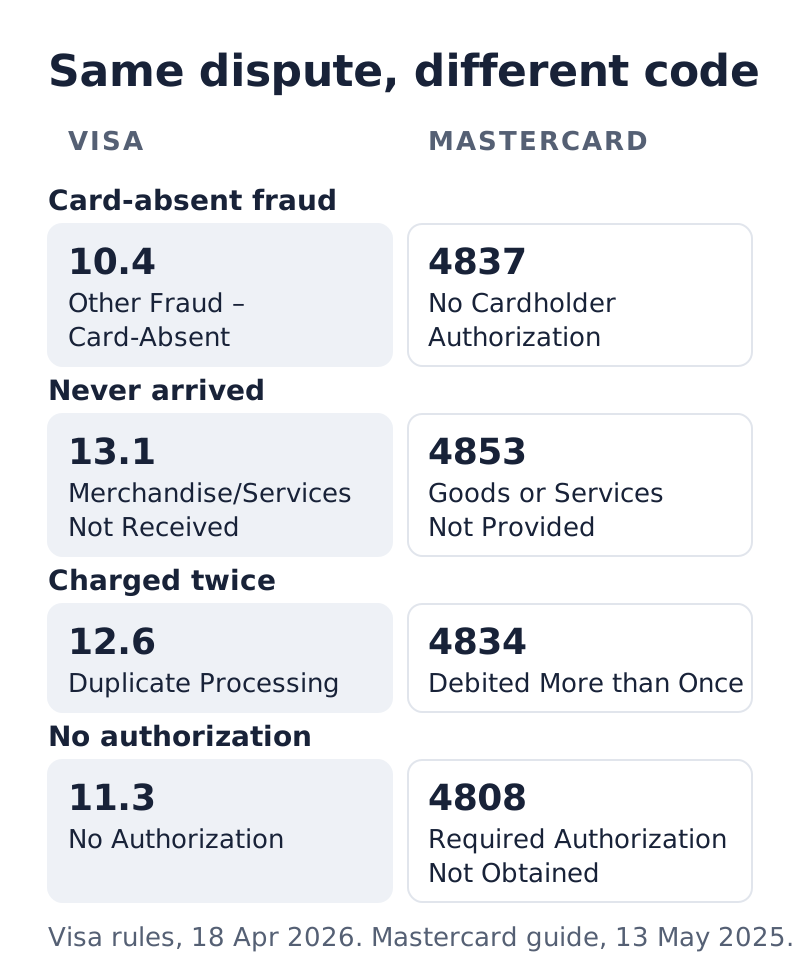
Mastercard 4853 also covers what Visa calls 13.3 (not as described), 13.6 (credit not processed) and 13.2 (cancelled recurring). Your processor will tell you what documents Mastercard needs.
Worked Examples
All three examples are hypothetical.
Example 1: a Visa 10.4 dispute on a $240 online order
A $240 web order is processed on 3 June 2026 and ships that day. On 20 July 2026 the issuer files a 10.4 dispute: the cardholder says they didn't place the order. The issuer was inside its window, which ran 120 calendar days to 1 October 2026.
- Was it authenticated? If the checkout ran Visa Secure and the authorization carried ECI 5 and a CAVV, the dispute is invalid under Visa's rules. Send the authentication data.
- Any earlier orders? The same card bought from you on 14 November 2025 and 9 February 2026, neither disputed or reported as fraud. Both fall inside the window Visa requires: more than 120 days before the 20 July dispute (so before 22 March 2026) and no more than 365 days (so after 20 July 2025).
- Does the data match? The IP address and full delivery address match on all three orders. That meets Visa's IP-plus-one-element test. Add a detailed description of all three purchases.
A yes to step 1, or to steps 2 and 3, gives you a case for the full $240.
Example 2: a Visa 13.1 merchandise not received dispute
A customer pays $156 on 1 September 2026 for three items, promised by 8 September. Two items arrive, worth $120 together; the third, worth $36, never ships. The customer contacts you, gets no answer and disputes under 13.1.
Visa limits a 13.1 dispute to the portion not received: $156 minus $120, or $36. One of Visa's two 120-day clocks starts on the last expected delivery date, 8 September, and runs to 6 January 2027.
If the issuer claims the full $156, send delivery confirmation showing the full street address for the package that arrived (Visa doesn't accept tracking with a partial address). For the missing $36 item, a refund before the dispute is the cheapest fix.
Example 3: a Mastercard 4853 not-as-described dispute
A customer pays $300 in one Mastercard transaction for a jacket ($180) and boots ($120). The boots split at the sole within a week, and the issuer files a 4853 under Goods or Services Were Either Not as Described or Defective, for $120.
Mastercard's guide says a chargeback may be for the full amount or a lesser one, and that several partial chargebacks on one transaction can't add up to more than the transaction, here $300. So the $120 chargeback leaves at most $180 open to any later dispute.
If you had already refunded the $120 before the chargeback arrived, your processor has to show that refund in a timely second presentment. Refund after the second presentment instead, and Mastercard's guide says the money has to be recovered outside the chargeback process, for example with a good-faith collection letter.
Where to Go From Here
Answer the specific condition the code names. If one code keeps repeating, fix the process behind it: authentication for 10.4, delivery proof for 13.1, clear policies for 13.7. This page is general information, not legal advice; your processor's instructions and the current network rules control any real dispute.
If chargebacks and their fees are eating into your margin, a free statement review from Payment USA shows what you're paying on each line of your merchant statement.
Sources
- Visa Core Rules and Visa Product and Service Rules, 18 April 2026 edition, chapter 11, Dispute Resolution (observed September 2026)
- Mastercard Chargeback Guide, Merchant Edition, 13 May 2025, chapters 1 and 2 (observed September 2026)
Frequently Asked Questions
What are chargeback reason codes?
They are the codes a card issuer attaches to a dispute to say why the cardholder wants the money back. Visa uses dispute conditions numbered 10.1 to 13.9, grouped into Fraud, Authorization, Processing Errors and Consumer Disputes. Mastercard uses four-digit codes such as 4837 and 4853.
What is chargeback reason code 10.4?
Visa 10.4 is Other Fraud – Card-Absent Environment: the cardholder denies making an online, phone or mail-order purchase. The issuer has 120 calendar days from the Transaction Processing Date to file it. Visa Secure authentication, or 2 earlier undisputed orders with matching device, IP or delivery data, can make it invalid.
What is Mastercard reason code 4853?
4853 (53 in short form) is Mastercard's Cardholder Dispute code. It covers goods or services not provided, not as described or defective, refunds not processed, counterfeit goods, recurring-billing disputes, no-show hotel charges and other consumer complaints.
What does chargeback reason code 37 mean?
37 is the short form of Mastercard 4837, No Cardholder Authorization. The cardholder says they did not make or allow the purchase. It is Mastercard's counterpart to Visa's fraud codes 10.3 and 10.4.
Are chargeback reason codes the same as decline codes?
No. A decline code comes back in the authorization response, before a sale completes. A chargeback reason code arrives after a sale has settled, when the cardholder's bank disputes it. Completing a sale after a decline can lead to a Visa 11.2 Declined Authorization chargeback.
About Payment USA’s Founder
Published by Payment USA, a merchant services provider. Our guides and comparisons reflect that commercial perspective.

Chase James
CEO, Payment USA
Chase James is the founder and CEO of Payment USA, a merchant services company built on transparency and fair pricing. With over 15 years in the payments industry, Chase has helped thousands of businesses uncover hidden processing fees and switch to honest, interchange-plus pricing.
Contact Chase →