What Is a Payment Gateway (And Why Does It Matter)?
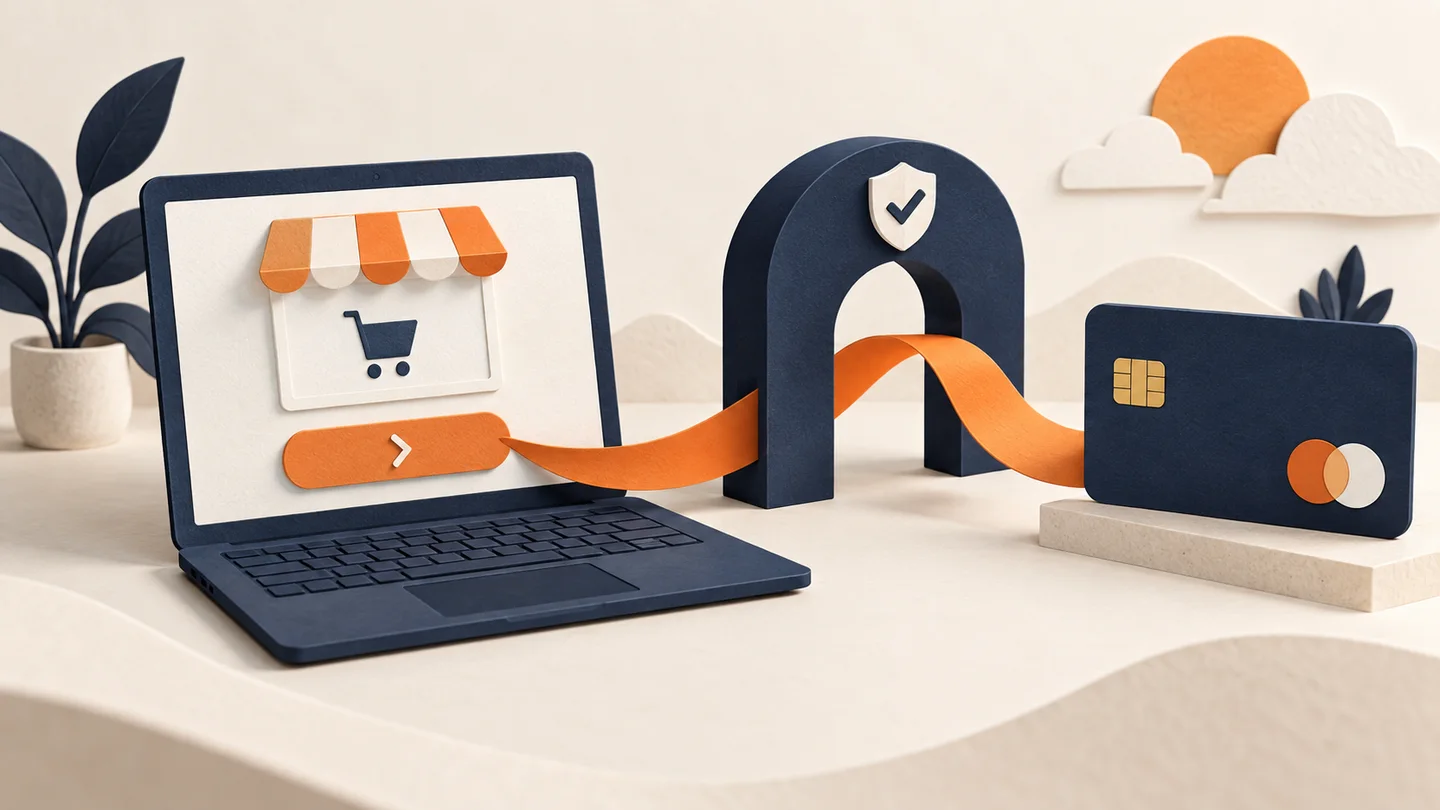
A payment gateway is the technology that securely transmits credit card data from your website to the payment processor. Think of it as the digital equivalent of a physical card terminal — it encrypts the card information, sends it to the processor for authorization, and returns an approval or decline to your checkout page.
But the gateway does more than just transmit data. The right gateway improves your checkout conversion rate, reduces fraud, expands your payment options, and integrates smoothly with your e-commerce platform. The wrong one creates friction, costs you sales, and leaves you vulnerable to fraud.
For e-commerce businesses — whether you're selling physical products, digital downloads, subscriptions, or services — your payment gateway is a critical piece of infrastructure.
Payment Gateway vs. Payment Processor: What's the Difference?
These terms are often confused, but they're different things:
| Component | What It Does |
| Payment Gateway | Encrypts and transmits card data from your website to the processor. The "front door." |
| Payment Processor | Routes the transaction through the card network, communicates with the issuing bank, and moves money. The "back office." |
| Merchant Account | The bank account where your processed funds are deposited. The "bank account." |
Some companies (like Stripe and Square) bundle all three into one service. Others (like Authorize.net, NMI, and USAePay) offer the gateway separately, letting you pair it with the processor and merchant account of your choice.
Why the distinction matters: When the gateway and processor are bundled, you can't change your processor without changing your gateway — which means rebuilding your checkout integration. When they're separate, you can shop for better processing rates without touching your website code.
Key Features to Evaluate
1. Platform Compatibility
Your gateway must integrate with your e-commerce platform. Common integrations:
| Platform | Compatible Gateways |
| Shopify | Shopify Payments (Stripe), PayPal, Authorize.net, NMI |
| WooCommerce | Stripe, PayPal, Authorize.net, Square, NMI, USAePay |
| BigCommerce | PayPal, Stripe, Authorize.net, Square |
| Magento | Authorize.net, Stripe, PayPal, Braintree |
| Custom-built | Any gateway with a well-documented API |
If your platform only works with one gateway (like Shopify's strong preference for Shopify Payments), understand the tradeoffs. Shopify charges higher rates if you use a third-party gateway (0.5%–2% additional fee on non-Shopify Payments transactions).
2. Checkout Experience
The checkout experience directly impacts your conversion rate. A clunky, confusing, or slow checkout loses sales.
What to look for:
- Hosted vs. embedded checkout: Hosted checkouts redirect to another site (like PayPal). Embedded checkouts keep the customer on your site. Embedded typically converts better.
- Mobile optimization: Over 60% of e-commerce traffic is mobile. Your checkout must render perfectly on phones.
- Guest checkout: Requiring account creation reduces conversion by 20%–35%. Always offer guest checkout.
- Saved payment methods: For returning customers, one-click purchasing dramatically increases repeat conversion.
- Minimal form fields: Every unnecessary field reduces conversion. Name, card number, expiration, CVV, billing ZIP — that's all you need for most transactions.
Benchmark: Top-performing e-commerce checkouts have a completion rate of 60%–70%. If yours is below 50%, your checkout flow is likely the problem, not your product or pricing.
3. Payment Method Support
Modern consumers expect options beyond basic credit cards:
| Payment Method | Why It Matters |
| Visa, Mastercard, Amex, Discover | Table stakes — must accept all four |
| Apple Pay / Google Pay | Faster checkout, higher mobile conversion |
| PayPal / Venmo | Trust factor for new customers; higher conversion for some demographics |
| ACH / bank transfer | Lower processing costs for high-ticket items |
| Buy Now, Pay Later (BNPL) | Afterpay, Klarna, Affirm — increases average order value by 20%–60% |
| International currencies | Required if selling globally |
| Digital wallets | WeChat Pay, Alipay for international customers |
4. Security Features
E-commerce transactions are card-not-present (CNP), which means higher fraud risk. Your gateway must include:
Essential security:
- PCI-DSS Level 1 compliance: The gateway handles card data, so it must meet the highest PCI standard
- Tokenization: Replaces card numbers with tokens so you never store actual card data
- Encryption: TLS 1.2+ for all data in transit
- 3D Secure 2.0: (Verified by Visa, Mastercard Identity Check) Adds a verification step for high-risk transactions, shifting liability for fraud from you to the card issuer
Fraud prevention tools:
- AVS (Address Verification Service): Matches billing address with the card issuer's records
- CVV verification: Requires the 3-digit security code on the back of the card
- Velocity checks: Flags multiple rapid transactions from the same card or IP
- IP geolocation: Flags transactions from high-risk countries or when the IP doesn't match the billing address
- Device fingerprinting: Identifies repeat fraudsters even when they use different cards
- Machine learning fraud scoring: Advanced systems score each transaction's fraud risk in real-time
5. Recurring Billing / Subscription Support
If you sell subscriptions, memberships, or recurring services, your gateway must support:
- Automatic card-on-file charging on a schedule
- Dunning management (automatic retry logic for failed payments)
- Customer self-service portal for updating payment methods
- Prorated billing and plan changes
- Card updater service (automatically updates expired card numbers)
Card updater is critical: Without it, when a customer's card expires or is reissued, their recurring payment fails. With it, the gateway automatically obtains the new card number from the issuing bank. This alone can reduce involuntary churn by 20%–40%.
6. Reporting and Analytics
Your gateway should provide:
- Transaction search and filtering (by date, amount, status, card type)
- Settlement reports (reconcile deposits with transactions)
- Chargeback tracking and management
- Decline code analysis (understand why transactions fail)
- Custom report exports (CSV, PDF)
Gateway Pricing Models
Transaction-Based (Most Common)
You pay per transaction: a percentage + a per-transaction fee.
Examples:
- Stripe: 2.9% + $0.30
- PayPal: 2.99% + $0.49
- Braintree: 2.59% + $0.49
Note: These are bundled rates — they include the gateway, processing, and merchant account all in one. Convenient, but not always the cheapest option for higher-volume businesses.
Separate Gateway Fee
When you use a standalone gateway with a separate processor, you typically pay:
- Gateway fee: $0.05–$0.15 per transaction + $10–$25/month
- Processing: interchange-plus markup from your processor
Example total cost on $30,000/month with 800 transactions:
- Gateway: $25/month + 800 × $0.10 = $105
- Processing at interchange + 0.25% + $0.10: ~$630
- Total: ~$735/month (effective rate: ~2.45%)
Compare to Stripe at 2.9% + $0.30:
- Total: ~$1,110/month (effective rate: ~3.70%)
Savings with separate gateway + interchange-plus: $375/month = $4,500/year
Reducing Cart Abandonment
The average cart abandonment rate is 70%. While not all of that is payment-related, a significant portion is. Here's what you can do:
Checkout Optimization
- Show total cost early — surprise fees at checkout are the #1 reason for abandonment
- Offer multiple payment options — Apple Pay, PayPal, and BNPL each capture different customer segments
- Use autofill support — ensure your forms work with browser autofill and password managers
- Show security badges — SSL seal, PCI compliance badge, and payment brand logos build trust
- Optimize for speed — checkout pages should load in under 2 seconds
Trust Signals
- Display a physical address and phone number
- Show real customer reviews near checkout
- Offer a clear, generous return policy
- Display "Secure Checkout" or "256-bit SSL Encryption" messaging
- Use recognizable payment brand logos
Chargeback Prevention for E-Commerce
E-commerce businesses face higher chargeback rates than brick-and-mortar stores because CNP transactions are more susceptible to fraud. Read our full chargeback prevention guide →
Quick wins:
- Use a clear billing descriptor (customers should recognize your business name on their statement)
- Send order confirmation and shipping notification emails
- Provide tracking numbers for all shipments
- Respond to customer service inquiries within 4 hours
- Implement 3D Secure for high-risk transactions
Frequently Asked Questions
What's the cheapest payment gateway for small e-commerce businesses?
For businesses under $10,000/month, Stripe or PayPal are often the most cost-effective because they have no monthly fees. Above $10,000/month, a separate gateway + interchange-plus processor typically saves money.
Can I use multiple payment gateways?
Yes. Many businesses use Stripe or PayPal as a secondary option alongside a primary gateway. This gives customers choices and provides a backup if one gateway has downtime.
Do I need a separate merchant account?
If you use Stripe, Square, or PayPal, no — they include a merchant account. If you use a standalone gateway like Authorize.net or NMI, yes — you'll need a separate merchant account with a processor.
How do I choose between Stripe and a traditional gateway?
Stripe is faster to set up and simpler to manage. A traditional gateway + interchange-plus processor saves money at higher volumes. The crossover point is typically around $15,000–$25,000/month.
What is PCI compliance for e-commerce?
If your gateway handles card data (you never see card numbers), you qualify for SAQ A — the simplest PCI questionnaire. If you use a hosted payment page, you have the least PCI burden. If you process cards on your own server, you need SAQ D — much more complex.
About Payment USA’s Founder
Published by Payment USA, a merchant services provider. Our guides and comparisons reflect that commercial perspective.

Chase James
CEO, Payment USA
Chase James is the founder and CEO of Payment USA, a merchant services company built on transparency and fair pricing. With over 15 years in the payments industry, Chase has helped thousands of businesses uncover hidden processing fees and switch to honest, interchange-plus pricing.
Contact Chase →