
Current US interchange rates come from two schedules: Visa's, effective April 18, 2026, and Mastercard's, effective April 17, 2026. On consumer credit, the main in-store and online rows run from 1.51% to 2.60% plus 10 cents, depending on the card, and 3.15% plus 10 cents when a sale falls to the non-qualified or standard rate. Debit cards from large banks are capped by federal rule at 0.05% plus 21 cents, plus 1 cent for fraud prevention.
This page is the rate reference: the most common rows, copied from the network documents with their exact labels, and worked examples you can check with a calculator. For how a processor builds a price on top of these numbers, read what interchange-plus pricing is.
What interchange is, and what you actually pay
Interchange is the fee the merchant's bank pays the cardholder's bank (the issuer) on each card sale. Visa and Mastercard publish the rates; the issuer receives them. Visa's own schedule is blunt about who pays it: "Merchants do not pay interchange reimbursement fees; merchants pay merchant discount" to their financial institution.
So the rates below are not a price anyone quotes you. They are one part of the merchant discount your processor charges. The rest is network fees, which go to Visa or Mastercard, and the processor's own markup.
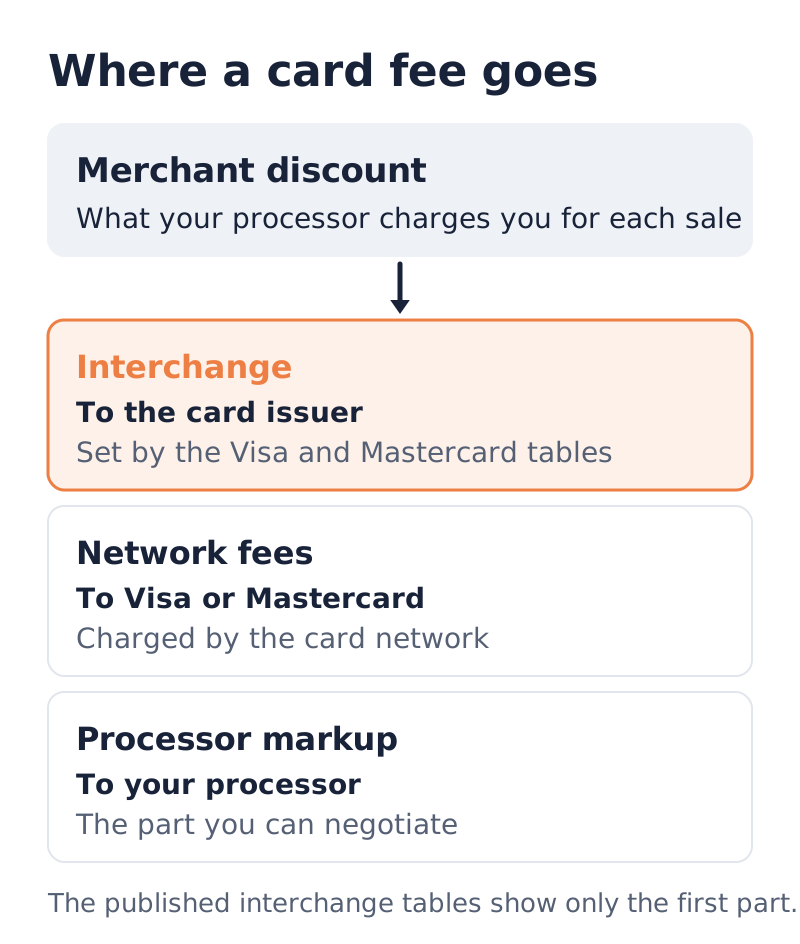
Two things the tables below do not cover. American Express works differently, so it has its own page on American Express interchange fees. And network fees are not in either schedule; your statement lists them separately, and our guide to reading a merchant statement shows where.
Current Visa credit card interchange rates
Visa's April 2026 schedule does not use CPS names for consumer credit, though it still does for debit. Its card-present table now lists rows such as Product 2, Restaurant 2 and Small Ticket, and its card-not-present table lists Product 1, Restaurant 1 and Recurring. The columns are six card products: Visa Infinite Spend Qualified, Visa Infinite Spend Not Qualified, Visa Signature Preferred, Visa Signature, Traditional Rewards and All Other Products.
Visa card-present credit rates
| Card product | Product 2 | Restaurant 2 | Supermarket Credit—All Other |
| Visa Infinite Spend Qualified | 2.30% + $0.10 | 2.60% (min. $0.04) | 2.00% + $0.07 |
| Visa Infinite Spend Not Qualified | 1.90% + $0.10 | 2.60% (min. $0.04) | 1.65% + $0.07 |
| Visa Signature Preferred | 2.10% + $0.10 | 2.60% (min. $0.04) | 2.00% + $0.07 |
| Visa Signature | 1.65% + $0.10 | 2.60% (min. $0.04) | 1.65% + $0.07 |
| Traditional Rewards | 1.65% + $0.10 | 2.10% (min. $0.04) | 1.50% + $0.07 |
| All Other Products | 1.51% + $0.10 | 2.10% (min. $0.04) | 1.50% + $0.07 |
Small Ticket is 2.20% (min. $0.04) on the four Infinite and Signature columns and 1.90% (min. $0.04) on Traditional Rewards and All Other Products. Visa's schedule does not print a ticket-size limit for that row.
The lower Retail Credit-Performance Threshold rows (for example 1.43% + $0.10 on Traditional Rewards at Threshold I) are for very large merchants. Visa's criteria table sets the smallest tier, Threshold III, at 19.2 million transactions and $1.08 billion in volume over 12 months, with a maximum dispute ratio of 0.020% and PCI compliance. Supermarket tiers work the same way.
Visa card-not-present interchange rates
This is the table for online, phone and mail orders.
| Card product | Product 1 | Restaurant 1 | Recurring |
| Visa Infinite Spend Qualified | 2.60% + $0.10 | 2.70% (min. $0.08) | 2.30% + $0.05 |
| Visa Infinite Spend Not Qualified | 2.20% + $0.10 | 2.70% (min. $0.08) | 1.53% + $0.05 |
| Visa Signature Preferred | 2.50% + $0.10 | 2.70% (min. $0.08) | 2.30% + $0.05 |
| Visa Signature | 2.05% + $0.10 | 2.70% (min. $0.08) | 1.53% + $0.05 |
| Traditional Rewards | 2.04% + $0.10 | 2.20% (min. $0.08) | 1.53% + $0.05 |
| All Other Products | 1.89% + $0.10 | 2.20% (min. $0.08) | 1.53% + $0.05 |
Visa also lists Card Not Present Incentives that come off the percentage: Type 1 is -0.05% (EMV Token transactions), Type 2 is -0.10% (Digital Commerce Authentication Program, or DCAP) and Type 3 is -0.15% (DCAP plus EMV Token). The schedule says they require CPS qualification, exclude Charity 1 and CPS/Utility, and are subject to change. For the fraud and liability side of remote sales, see our guide to card-not-present transactions.
Visa small merchant rates
Visa runs a separate Small Merchant Fee Program for merchants with no more than $280,000 in gross Visa consumer credit sales, based on 12 months ending September 30, 2024.
| Card product | Small Merchant Product 2 | Small Merchant Product 1 |
| Visa Infinite Spend Qualified | 1.88% + $0.10 | 2.18% + $0.10 |
| Visa Infinite Spend Not Qualified | 1.43% + $0.10 | 1.73% + $0.10 |
| Visa Signature Preferred | 1.88% + $0.10 | 2.18% + $0.10 |
| Visa Signature | 1.43% + $0.10 | 1.73% + $0.10 |
| Traditional Rewards | 1.43% + $0.10 | 1.73% + $0.10 |
| All Other Products | 1.29% + $0.10 | 1.58% + $0.10 |
The schedule notes that a small merchant transaction that disqualifies from the program is assessed at the next applicable rate.
Worked example: one $60.00 Visa sale, three ways
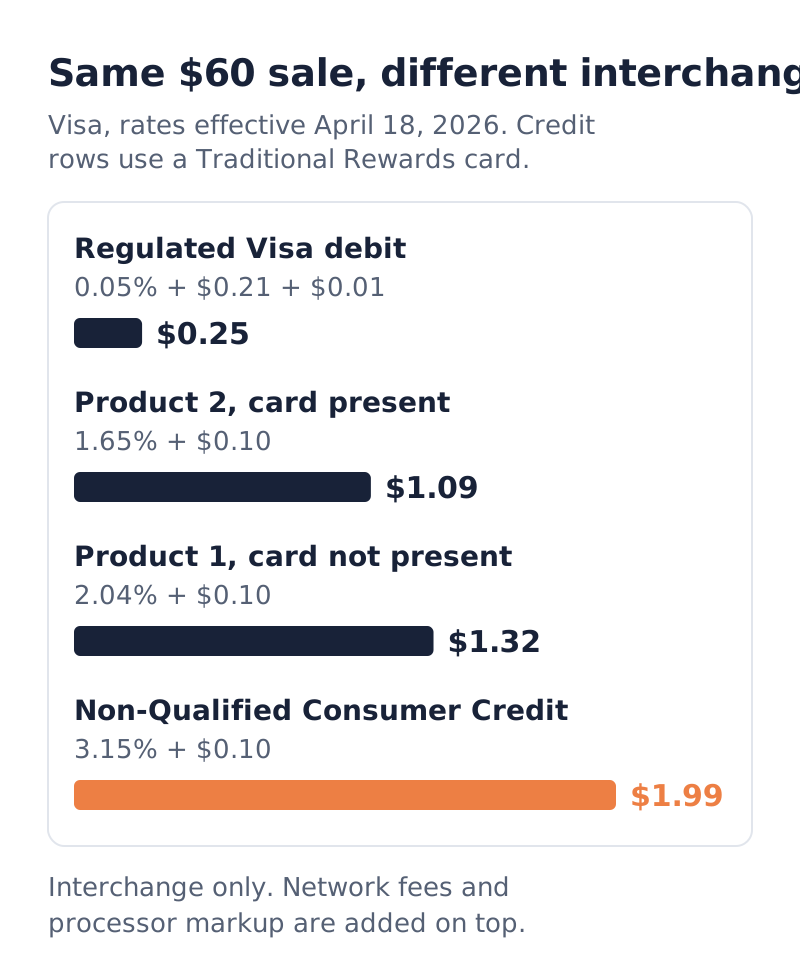
A customer pays $60.00 with a Visa Traditional Rewards credit card.
- In the store, card present (Product 2, 1.65% + $0.10): $60.00 × 0.0165 = $0.99, plus $0.10 = $1.09.
- Online, card not present (Product 1, 2.04% + $0.10): $60.00 × 0.0204 = $1.224, plus $0.10 = $1.324, about $1.32.
- Non-qualified (Non-Qualified Consumer Credit, 3.15% + $0.10): $60.00 × 0.0315 = $1.89, plus $0.10 = $1.99.
The same $60.00 on a regulated Visa debit card is 0.05% + $0.21: $60.00 × 0.0005 = $0.03, plus $0.21 = $0.24, plus $0.01 if the issuer has certified its fraud-prevention compliance = $0.25.
Current Mastercard credit card interchange rates
Mastercard's consumer credit table has five card levels: Core Value, Enhanced Value, World, World High Value and World Elite. A useful detail for anyone taking cards by phone or online: on consumer credit, Mastercard prints the same rate for Merit I, Key-entered and Full UCAF at every card level.
| Card level | Merit I, Key-entered, Full UCAF | Merit III Base | Standard |
| Core Value | 1.95% + $0.10 | 1.65% + $0.10 | 3.15% + $0.10 |
| Enhanced Value | 2.10% + $0.10 | 1.80% + $0.10 | 3.15% + $0.10 |
| World | 2.20% + $0.10 | 1.90% + $0.10 | 3.15% + $0.10 |
| World High Value | 2.60% + $0.10 | 2.30% + $0.10 | 3.15% + $0.10 |
| World Elite | 2.60% + $0.10 | 2.30% + $0.10 | 3.15% + $0.10 |
| Card level | Restaurant | Supermarket Base | Small Ticket Card Present |
| Core Value | N/A | 1.45% + $0.10 | 1.65% + $0.02 |
| Enhanced Value | N/A | 1.60% + $0.10 | 1.80% + $0.02 |
| World | 1.85% + $0.10 | 1.70% + $0.10 | 1.90% + $0.02 |
| World High Value | 2.00% + $0.10 | 2.10% + $0.10 | 2.30% + $0.02 |
| World Elite | 2.00% + $0.10 | 2.10% + $0.10 | 2.30% + $0.02 |
Mastercard's footnote says Small Ticket rates apply to transactions of $5 and below. Small Ticket Card-Not-Present runs 1.95%, 2.10%, 2.20%, 2.60% and 2.60%, each plus $0.02, across the same five levels. The lower Merit III and Supermarket tiers require very high annual volume (Merit III Tier 3 starts at $750 million in consumer credit volume) and a Mastercard-approved merchant ID. Some rows are tied to merchant category codes, such as Merit I for insurance (MCCs 5960 and 6300) and real estate (MCC 6513).
Debit card interchange: exempt vs regulated
Debit rates split in two. Under the Federal Reserve's Regulation II, a debit issuer that, with its affiliates, has total assets of $10 billion or more is covered by a cap. An issuer below $10 billion is exempt, and its cards earn the network's published exempt rates, which are higher.
The Regulation II cap (Durbin)
The Fed's rule limits a covered issuer's interchange to 21 cents plus 5 basis points (0.05%) of the transaction, plus up to 1 cent if the issuer meets the Fed's fraud-prevention standards. On a $50 sale that works out to 21 + 2.5 + 1 = 24.5 cents, the figure the Fed itself uses. In October 2023 the Board proposed lowering the cap; its proposal page gives May 12, 2024 as the comment deadline, and the Board's Regulation II page, as observed September 2026, lists no final rule on that proposal. The cap above is the one stated in the Fed's Regulation II compliance guide. This is general information, not legal advice.
Visa debit rates, exempt and regulated
| Visa fee program | Exempt Visa Check Card | Regulated Visa Check Card |
| CPS/Retail, Debit | 0.80% + $0.15 | 0.05% + $0.21 |
| CPS/Supermarket, Debit | $0.30 | 0.05% + $0.21 |
| CPS/Restaurant, Debit | 1.19% + $0.10 | 0.05% + $0.21 |
| CPS/Small Ticket, Debit | 1.55% + $0.04 | 0.05% + $0.21 |
| CPS/Retail Key Entry, Debit | 1.65% + $0.15 | 0.05% + $0.21 |
| CPS/Card Not Present, Debit | 1.65% + $0.15 | 0.05% + $0.21 |
| CPS/e-Commerce Preferred Retail, Debit | 1.60% + $0.15 | 0.05% + $0.21 |
| EIRF, Debit | 1.75% + $0.20 | 0.05% + $0.21 |
| Standard Interchange Reimbursement Fee, Debit | 1.90% + $0.25 | 0.05% + $0.21 |
Every regulated row carries Visa's footnote that certified issuers receive an additional $0.01.
Mastercard debit rates
| Mastercard program | Unregulated debit | Unregulated prepaid |
| Merit I | 1.65% + $0.15 | 1.76% + $0.20 |
| Key-Entered | 1.65% + $0.15 | 1.76% + $0.20 |
| Merit III Base | 1.05% + $0.15 | 1.15% + $0.15 |
| Restaurant | 1.19% + $0.10 | 1.19% + $0.10 |
| Small Ticket Base | 1.55% + $0.04 | 1.55% + $0.04 |
| Supermarket Base | 1.05% + $0.15 (0.35 max) | 1.05% + $0.15 (0.35 max) |
| Standard | 1.90% + $0.25 | 1.90% + $0.25 |
For regulated cards, Mastercard lists Regulated POS Debit at 0.05% + $0.21 and Regulated POS Debit with Fraud Adjustment at 0.05% + $0.22. Our page on debit card processing fees covers PIN versus signature debit and routing.
Worked example: a $45.00 online order
A shopper checks out on your website for $45.00.
| Card used | Rate row | Interchange |
| Mastercard World Elite credit | Merit I or Full UCAF, 2.60% + $0.10 | $1.17 + $0.10 = $1.27 |
| Mastercard Core Value credit | Merit I or Full UCAF, 1.95% + $0.10 | $0.8775 + $0.10 = $0.9775, about $0.98 |
| Mastercard unregulated debit | Merit I, 1.65% + $0.15 | $0.7425 + $0.15 = $0.8925, about $0.89 |
| Mastercard regulated debit | With Fraud Adjustment, 0.05% + $0.22 | $0.0225 + $0.22 = $0.2425, about $0.24 |
The premium card costs you about $1.03 more than the regulated debit card on the same order ($1.27 minus $0.24), and you do not choose which card the customer uses. If the World Elite sale fell to Standard instead, it would be $45.00 × 0.0315 = $1.4175, plus $0.10 = $1.5175, about $1.52.
What makes a sale land in Standard or Non-Qualified
Both networks publish a fallback rate that is higher than the rows above:
- Visa consumer credit: Non-Qualified Consumer Credit, 3.15% + $0.10, the same on all six card products.
- Mastercard consumer credit: Standard, 3.15% + $0.10, the same on all five card levels.
- Visa exempt debit: Electronic Interchange Reimbursement Fee (EIRF), Debit, at 1.75% + $0.20, and Standard Interchange Reimbursement Fee, Debit, at 1.90% + $0.25.
- Mastercard unregulated debit: Standard, 1.90% + $0.25.
Regulated debit works differently. Every regulated Visa row, fallback rows included, is 0.05% + $0.21, and Mastercard's regulated rows are 0.05% + $0.21 or $0.22 with the fraud adjustment.
The public schedules say little about why a sale drops. Visa's schedule refers readers to its U.S. Interchange Reimbursement Fee Rate Qualification Guide for complete details, and we could not find that guide in public form. What the rate tables themselves show:
- Card-not-present incentives apply only to transactions that meet CPS qualification.
- A small merchant transaction that fails the program's requirements moves to the next applicable rate.
- The Visa performance thresholds set a maximum dispute ratio of 0.020% and require PCI compliance.
- On cards issued outside the US, Visa's international table has a row actually labeled Downgrade: 1.65% on Visa Classic, Gold and Electron against 1.10% for Product Base.
If your statement shows many sales at 3.15% or at EIRF, ask your processor for the qualification reason on each.
Business and commercial cards
Commercial cards have their own tables. In Visa's corporate and purchasing card table, Commercial Card Present is 2.50% + $0.10, Commercial Card Not Present is 2.70% + $0.10 and Non-Qualified is 2.95% + $0.10. If you sell to other businesses, read our page on Level 2 and Level 3 processing before assuming those cards cost what consumer cards do.
From interchange rates to your actual cost
The tables show what the issuer receives. Your processor then adds network fees and its own markup, either as a visible line under interchange-plus pricing or folded into a flat or tiered rate. To see what your mix of cards and ticket sizes costs, run it through our credit card processing fee calculator, and compare the result with your statement.
If the effective rate on your statement is well above the interchange rows your sales should qualify for, the difference is markup and fallback rates. Payment USA offers a free statement review if you want a second set of eyes on those lines.
Sources
- Visa USA Interchange Reimbursement Fees, rates effective April 18, 2026, observed September 2026.
- Mastercard 2026-2027 U.S. Region Interchange Programs and Rates, effective April 17, 2026, linked from Mastercard merchant interchange rates, observed September 2026.
- Federal Reserve, Regulation II compliance guide (interchange fee standards and small issuer exemption), observed September 2026.
- Federal Reserve, Regulation II (Debit Card Interchange Fees and Routing), observed September 2026.
- Federal Reserve, October 25, 2023 press release on the proposal to lower the debit interchange cap, observed September 2026.
- Federal Reserve, Regulation II proposal details, observed September 2026.
Frequently Asked Questions
What are the current Visa and Mastercard interchange rates?
Visa's current US schedule took effect April 18, 2026 and Mastercard's on April 17, 2026. On consumer credit, Visa's general card-present row (Product 2) runs from 1.51% + $0.10 on All Other Products to 2.30% + $0.10 on Visa Infinite Spend Qualified, and Mastercard's Merit I runs from 1.95% + $0.10 on Core Value to 2.60% + $0.10 on World Elite. Both networks' fallback credit rate is 3.15% + $0.10.
What is the Visa card-not-present interchange rate?
For consumer credit, Visa's Product 1 row in the card-not-present table is 2.04% + $0.10 on a Traditional Rewards card, 1.89% + $0.10 on All Other Products, and up to 2.60% + $0.10 on Visa Infinite Spend Qualified, effective April 18, 2026. Qualifying tokenized or authenticated transactions can earn incentives of 0.05% to 0.15% off the percentage.
What is the debit card interchange cap?
Under the Federal Reserve's Regulation II, debit issuers with $10 billion or more in assets (with affiliates) can receive no more than 21 cents plus 0.05% of the transaction, plus up to 1 cent if they meet the Fed's fraud-prevention standards. On a $50 sale that is 24.5 cents. The Fed proposed lowering the cap in October 2023; as of September 2026 its Regulation II page lists no final rule on that proposal.
Do merchants pay interchange directly?
No. Visa's schedule states that merchants pay a merchant discount to their financial institution, not interchange. Interchange is paid between the banks and is one part of the merchant discount, alongside network fees and the processor's markup.
Why is my card sale charged 3.15%?
3.15% + $0.10 is the fallback consumer credit rate on both networks: Visa calls it Non-Qualified Consumer Credit and Mastercard calls it Standard. A sale lands there when it misses the requirements for a lower rate. Visa's detailed criteria are in a separate qualification guide we could not find in public form, so ask your processor for the reason on each affected sale.
About Payment USA’s Founder
Published by Payment USA, a merchant services provider. Our guides and comparisons reflect that commercial perspective.

Chase James
CEO, Payment USA
Chase James is the founder and CEO of Payment USA, a merchant services company built on transparency and fair pricing. With over 15 years in the payments industry, Chase has helped thousands of businesses uncover hidden processing fees and switch to honest, interchange-plus pricing.
Contact Chase →