> Written by Chase James, CEO of Payment USA. With 15+ years underwriting restaurant merchant accounts, I've watched pay at table terminals go from a nice-to-have to a must-have — operators using them turn tables faster and earn measurably more tips.
If you run a full-service restaurant in 2026 and your servers are still walking guest credit cards back to a stationary POS, you are leaving money on the table — literally. Pay at table terminals have become the standard across casual dining, fine dining, and even high-volume bars, because the math is hard to argue with: faster table turns, higher tips, lower chargeback exposure, and a measurable lift in guest satisfaction scores.
This guide walks through how restaurant payment terminals actually work, what they cost in 2026, which features matter for different restaurant formats, and how to avoid the contract traps that still plague the industry.
Why Pay at Table Terminals Won
Five years ago, tableside payments felt like a European import — common in Paris and London, rare in Dallas or Denver. Today, every major POS platform (Toast, Square for Restaurants, Clover, TouchBistro, Lightspeed) ships first-class support for handheld tableside devices, and the operational data behind the shift is overwhelming.
A typical full-service check pays out like this with the old "pay at counter" workflow: the server drops the bill, waits 3–4 minutes for the guest to flag them down, picks up the card, walks to the POS, swipes or inserts, prints the slip, walks back, waits for signature and tip. Total elapsed time: 6–8 minutes per table, and that's when nothing goes wrong. With pay at table terminals, the same transaction completes in 45–90 seconds.
For a 60-seat restaurant doing two and a half turns per shift, that time savings translates to roughly one extra turn per server per night. At an average ticket of $42, that's $84–$126 in incremental revenue per server per shift — and they earn higher tips on every one of those checks because the on-screen prompts default to 18%, 20%, and 25%.
How Restaurant Payment Terminals Work
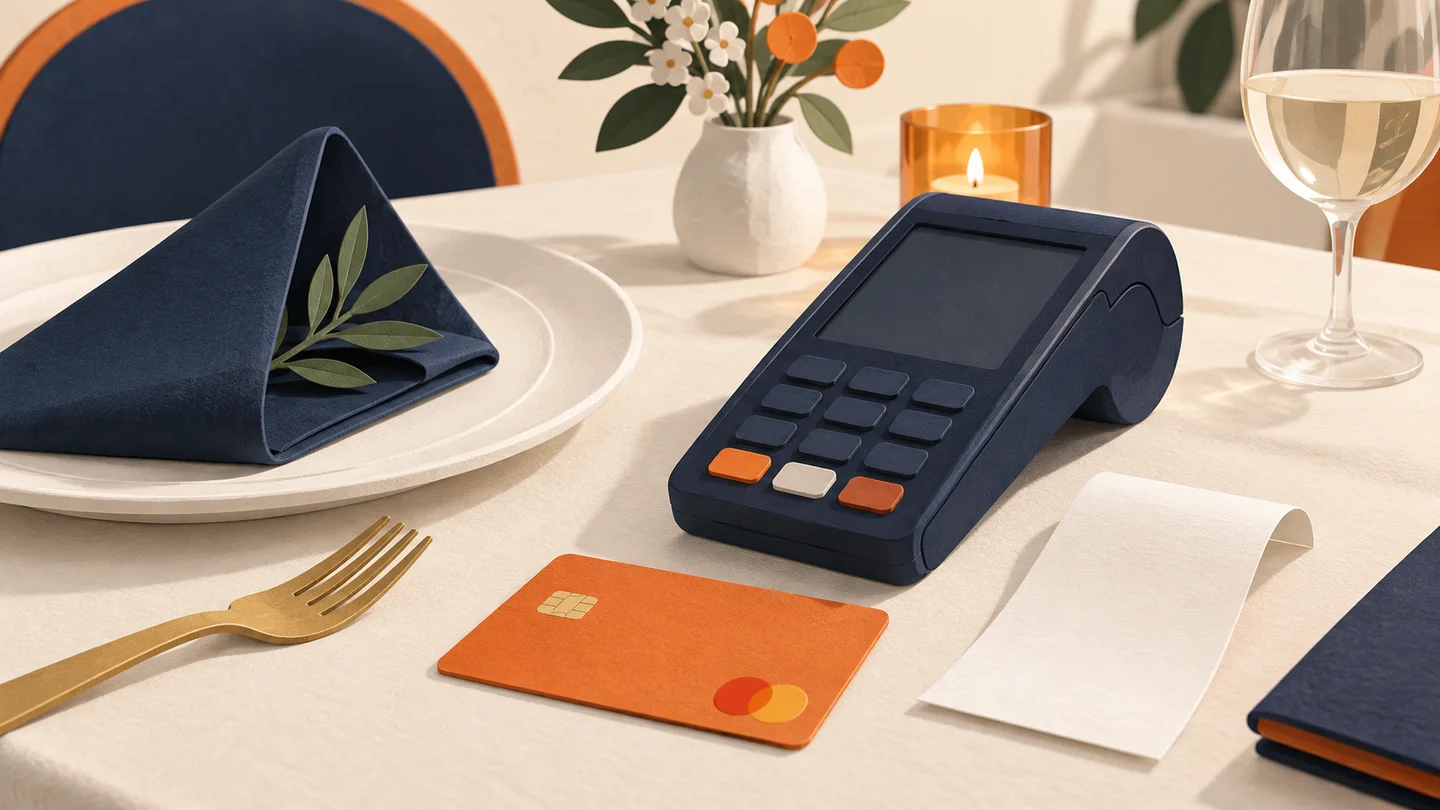
A modern tableside terminal is a hardened, EMV-certified handheld device that connects to your POS over Wi-Fi, 4G/LTE, or Bluetooth gateway. The flow:
- The server fires the check from the POS and dispatches it to a specific terminal (or the guest scans a QR code to pull their tab onto any available device).
- The terminal displays the full itemized check.
- The guest selects tip percentage or custom amount, splits the bill if needed, and taps, dips, or swipes their card. Contactless and digital wallets (Apple Pay, Google Pay) are standard.
- The card data is encrypted at the chip read, transmitted to the processor, and authorization comes back in 2–4 seconds.
- The receipt is emailed, texted, or printed at the terminal — and the POS marks the check closed automatically.
Crucially, the card never leaves the customer's sight, which eliminates one of the most common sources of restaurant card fraud (skimming during the "card walk") and reduces your PCI compliance scope.
Restaurant Payment Terminals: Choosing the Right Form Factor
Not every restaurant needs the same device. The four common form factors:
1. Full Handheld (Verifone V400m, Ingenico Move 5000, PAX A920 Pro, Clover Flex)
The workhorse of casual and fine dining. 5–6 inch color touchscreen, integrated thermal printer, all-day battery, hot-swap or charging cradle. $400–$700 retail. Best for: full-service restaurants, gastropubs, hotel F&B.
2. Pocket Reader + Phone (PAX A35, Square Terminal Pico)
Smaller, lighter, no on-device printer (receipts go via email/SMS). $200–$350. Best for: food trucks, pop-ups, sommeliers in fine dining who only need to close VIP checks tableside.
3. Integrated POS Handheld (Toast Go 2, Square Handheld, Clover Mini)
Full POS + payment in one device — servers take the order and the payment on the same screen. $500–$900 plus monthly POS subscription. Best for: fast casual, ghost kitchens, high-volume brunch spots.
4. QR Pay at Table (Toast Mobile Order & Pay, Square QR Pay, Sunday)
No hardware on the table at all — a QR code on the check lets the guest pay from their own phone. Best layered on top of a traditional handheld solution, not as a replacement. Best for: bars with heavy tab volume, breweries, sports venues.
What Pay at Table Terminals Cost in 2026
Honest hardware and processing benchmarks for restaurants:
| Component | Typical Cost |
| Handheld terminal (purchase) | $300 – $700 each |
| Handheld lease (avoid 48-mo leases) | $20 – $45 / month |
| POS-integrated handheld | $500 – $900 each |
| Processing (interchange-plus) | Interchange + 0.20% + $0.10/txn |
| Processing (flat-rate aggregator) | 2.6% – 2.9% + $0.10 |
| Tableside add-on fee (some POS) | $5 – $15 / device / month |
If you're being quoted a lease of $50–$75/month for 48 months on a $400 device, run the math: that's $2,400–$3,600 for hardware you could buy outright for less than $500. Equipment leases are one of the most common forms of overcharge in restaurant payments.
We cover the broader fee landscape in our interchange-plus pricing guide and our credit card processing fees explainer.
The Hidden Wins: Tips, Chargebacks, and Labor
The headline benefit of pay at table terminals is speed. The bigger long-term benefits are three less-discussed wins:
Tip uplift. Default tip prompts of 18/20/25% on a touchscreen consistently outperform a blank tip line on a paper slip. Operators report 15–25% higher average tip percentages within the first 60 days of switching — money that goes directly to your servers, which improves retention in a tight labor market.
Chargeback reduction. EMV chip transactions shift fraud liability from the merchant to the card issuer. Card-walked, key-entered, or fallback-swipe transactions do not. Restaurants that move to 100% chip-at-table see card-present chargeback rates drop by 60–80%.
Labor productivity. When servers stop walking checks, you need fewer servers to cover the same dining room — or your existing servers cover more tables and earn more tips. Either outcome improves your labor cost percentage, which is the single most volatile line item in a restaurant P&L.
Common Mistakes When Rolling Out Pay at Table Terminals
After helping hundreds of restaurants deploy tableside payments, these are the rollout mistakes we see repeatedly:
- Buying too few devices. Rule of thumb: one handheld per two servers, plus one spare in the charging cradle. Underprovisioning recreates the bottleneck you were trying to solve.
- Skipping the staff training session. A 30-minute pre-shift walkthrough on day one prevents a week of frustrated servers and slow checks.
- Using restaurant Wi-Fi without a dedicated SSID. Your payment terminals should be on their own network, separate from guest Wi-Fi. This protects PCI scope and prevents guests killing your throughput.
- Not enabling digital receipts by default. Paper receipts at the table negate half the time savings. Set email/SMS as the default and only print on request.
- Signing a 36-month merchant agreement to "qualify" for free hardware. Free hardware is almost always paid for through inflated processing rates or junk fees. Month-to-month service with hardware bought at cost is almost always the better long-term math.
Pay at Table Terminals + Cash Discount Programs
A growing number of restaurants pair tableside terminals with a compliant cash discount program, which displays a small discount for cash payment (and the equivalent surcharge for card) directly on the tableside screen. Properly implemented, this eliminates 90%+ of your processing cost while staying compliant with card-network rules and state law. The tableside terminal handles the disclosure automatically — the guest sees the cash price and the card price side by side and chooses.
This is especially powerful for full-service restaurants where average tickets are $40+ and processing fees on a single check can exceed $1.50.
FAQs: Pay at Table Terminals for Restaurants
Q: What are pay at table terminals?
A: Pay at table terminals are wireless, EMV-capable payment devices that servers bring directly to the guest's table so the card never leaves the customer's sight. The guest taps, inserts, or swipes, reviews the bill, adds a tip, and signs — all in 30–60 seconds.
Q: How much do restaurant payment terminals cost?
A: Standalone wireless tableside terminals typically cost $300–$700 to purchase outright, or $20–$45/month to lease. Avoid 48-month leases.
Q: Do pay at table terminals increase tips?
A: Yes — operators consistently report tip averages rising 15–25% after switching from paper checks to tableside terminals.
Q: Are pay at table terminals PCI compliant?
A: Yes. Modern tableside terminals are EMV-certified and PCI PTS approved. Card data is encrypted at the terminal and never touches your POS in readable form.
Q: Can pay at table terminals split checks?
A: Yes. Modern tableside devices support even splits, custom splits, split-by-item, and partial payments, posted back to the POS in real time.
Bottom Line
If you're a full-service restaurant operator and you're still walking checks, pay at table terminals are the single highest-ROI technology investment you can make in 2026. The hardware pays for itself in 60–90 days through tip uplift and faster table turns alone — and that's before you count the reduction in chargebacks and PCI exposure.
See what tableside processing would cost your restaurant — free statement review →
Frequently Asked Questions
What are pay at table terminals?
Pay at table terminals are wireless, EMV-capable payment devices that servers bring directly to the guest's table so the card never leaves the customer's sight. The guest taps, inserts, or swipes, reviews the bill, adds a tip, and signs — all in 30–60 seconds without the server walking the card to a stationary POS.
How much do restaurant payment terminals cost?
Standalone wireless tableside terminals typically cost $300–$700 to purchase outright, or $20–$45/month to lease. Avoid 48-month leases — they often total $2,000+ for a $400 device. Most reputable processors will sell the hardware at cost when you process with them.
Do pay at table terminals increase tips?
Yes. Operators consistently report tip averages rising 15–25% after switching from paper checks to tableside terminals, primarily because the on-screen prompts default to 18%, 20%, and 25% suggestions instead of a blank tip line.
Are pay at table terminals PCI compliant?
Modern tableside terminals from major manufacturers (Verifone, Ingenico, PAX, Clover, Dejavoo) are EMV-certified and PCI PTS approved. The card data is encrypted at the terminal and never touches your POS or Wi-Fi network in readable form, which actually reduces your PCI scope compared to swipe-at-the-counter setups.
What's the difference between pay at table and pay at counter?
Pay at counter requires the server to take the card away, run it at a stationary terminal, then return for signature — usually 4–6 minutes round trip. Pay at table happens at the guest's table in under a minute, eliminates card walks (a leading source of skimming and fraud), and frees the server to take the next table's order.
Can pay at table terminals split checks?
Yes. Almost every modern tableside device supports even splits, custom splits, split-by-item, and partial payments. The terminal communicates with the POS in real time so each split posts back to the correct ticket without manual reconciliation.
About Payment USA’s Founder
Published by Payment USA, a merchant services provider. Our guides and comparisons reflect that commercial perspective.

Chase James
CEO, Payment USA
Chase James is the founder and CEO of Payment USA, a merchant services company built on transparency and fair pricing. With over 15 years in the payments industry, Chase has helped thousands of businesses uncover hidden processing fees and switch to honest, interchange-plus pricing.
Contact Chase →