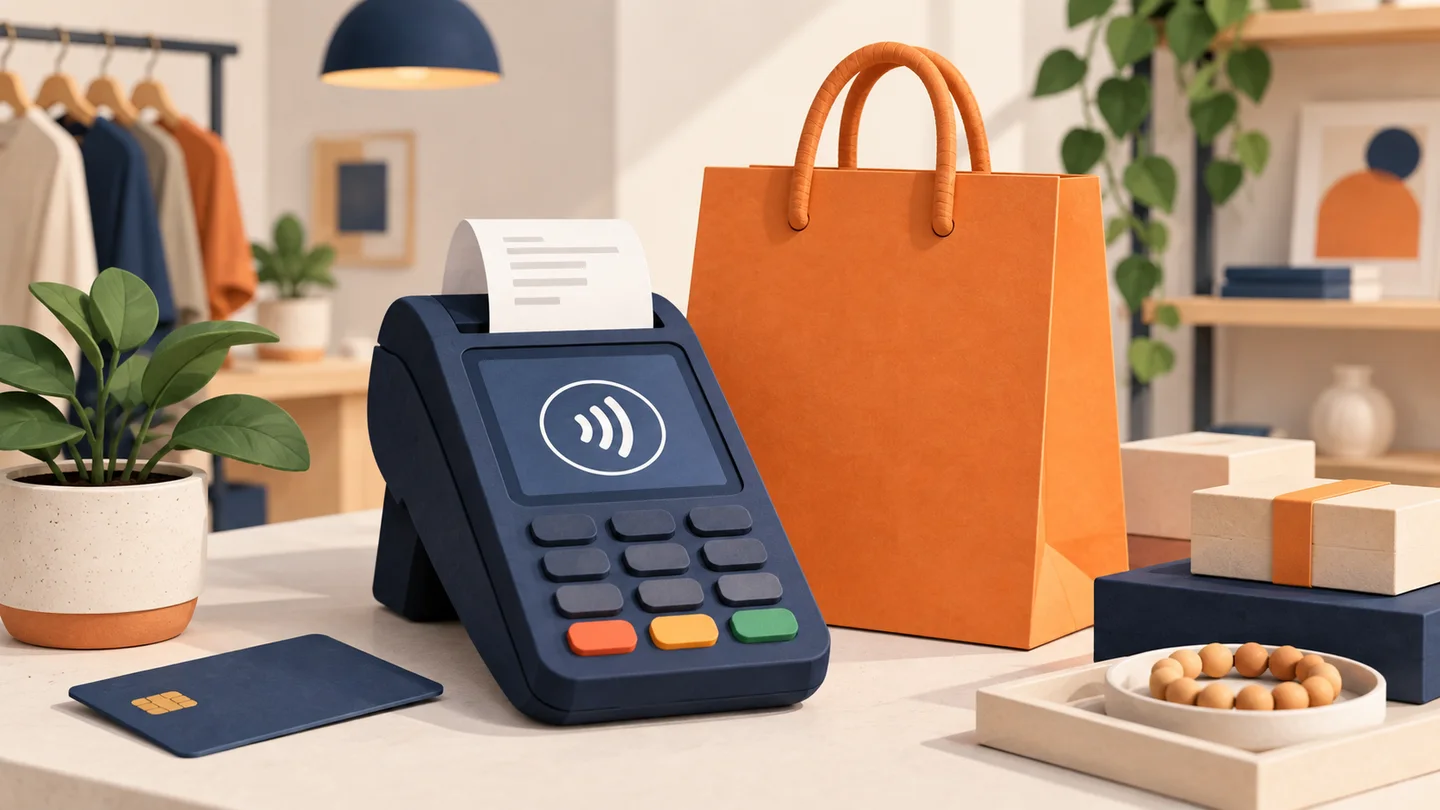
Retail Checkout Is Where Sales Are Won or Lost
In retail, the checkout experience is the last impression your customer has before they leave your store. A smooth, fast payment process reinforces a positive shopping experience. A slow, clunky, or error-prone checkout can undo everything your store does right — from merchandising to customer service.
But checkout speed is only part of the equation. For retail store owners, payment processing is also one of the largest controllable operating expenses. A typical retail business pays 2%–3.5% of every card transaction in processing fees. On $40,000/month in card sales, that's $800–$1,400/month going to your processor.
This guide covers both sides: how to make your checkout faster and more customer-friendly, and how to reduce what you pay for every transaction.
Understanding Retail Interchange Categories
Retail businesses benefit from some of the lowest interchange rates in the industry — but only if your transactions are categorized correctly. Visa and Mastercard have specific interchange categories for retail that offer lower rates than the "standard" categories that apply to many other business types.
How to Qualify for Retail Interchange Rates
To qualify for the best retail interchange rates, your transactions must meet certain criteria:
- Card-present — The physical card must be present and processed via chip (EMV) or contactless. Keyed-in transactions get higher rates.
- Authorization and settlement match — The authorized amount must match the settled amount. If they don't match (common with tip adjustments, which retail shouldn't have), you may get downgraded.
- Settled within 24 hours — Transactions should be batched (settled) within 24 hours of authorization. Delayed settlement can trigger higher interchange categories.
- Valid MCC — Your Merchant Category Code must correctly identify you as a retail business.
Common mistake: Retail merchants who frequently key in transactions (instead of swiping/dipping/tapping) pay significantly higher interchange rates. A keyed-in Visa rewards card might cost 2.30% + $0.10, while the same card dipped costs 1.65% + $0.10. On $30,000/month in keyed transactions, that's an extra $195/month — $2,340/year — in unnecessary costs.
Fix: If a customer's chip doesn't work, ask for another card or use the contactless reader rather than keying in the number.
Speed Up Your Checkout
Contactless Payments Are Non-Negotiable
In 2026, contactless payments account for over 40% of in-store transactions. Tap-to-pay completes in under one second — compared to 3–5 seconds for chip insertion and 6–8 seconds for swipe-and-sign.
For a retail store processing 200 transactions/day, contactless saves approximately 10–15 minutes of cumulative checkout time per day. During peak shopping periods — holidays, back-to-school, weekends — that time savings translates directly to serving more customers and reducing line abandonment.
To enable contactless:
- Ensure your terminal supports NFC (most terminals manufactured after 2020 do)
- Enable Apple Pay, Google Pay, and Samsung Pay acceptance
- Display contactless-accepted signage at the register
- Train staff to prompt customers: "You can tap if you'd like"
Optimize Your Terminal Setup
- Placement — The terminal should face the customer, not the cashier. Customer-facing terminals speed up the process because customers can interact directly without waiting for the cashier to rotate the device.
- Screen prompts — Minimize the number of prompts. Every "Press OK to continue" or "Would you like cash back?" adds seconds. Configure your terminal to skip unnecessary prompts for your business type.
- Receipt options — Offer digital receipts (email or text) as the default. This eliminates paper receipt printing time and reduces supply costs.
Train Your Staff
The fastest terminal in the world is useless if your cashier doesn't know how to use it efficiently. Train staff on:
- Starting the payment process while scanning the last few items (parallel processing)
- Handling common error scenarios (declined cards, chip errors) without calling a manager
- Prompting contactless payment for faster completion
- Quickly resolving mismatches between scanned and processed amounts
Reducing Retail Processing Costs
Strategy 1: Interchange-Plus Is Essential for Retail
Retail businesses on interchange-plus pricing typically save 15–25% compared to tiered pricing. Because retail qualifies for lower interchange categories, the savings are especially pronounced — tiered pricing hides those low interchange rates behind inflated "qualified" rates.
Example: A boutique clothing store processing $35,000/month on tiered pricing at 2.9% effective rate = $1,015/month. On interchange-plus at 2.1% effective = $735/month. Savings: $280/month = $3,360/year.
Strategy 2: Encourage Debit Card Usage
Regulated debit cards (from banks with over $10 billion in assets) are capped at 0.05% + $0.21 per transaction by the Durbin Amendment. This means a $100 debit card purchase costs you approximately $0.26 in interchange — compared to $1.65–$2.40 for a credit card.
How to encourage debit:
- If allowed in your state, offer a small cash discount or debit discount
- Ensure your terminal prompts for PIN (debit) vs. signature (credit) routing — PIN debit is cheaper
- For cash discount programs, the service fee only applies to credit transactions, naturally incentivizing debit and cash
Strategy 3: Batch Settlement Timing
Settle your batch every day — ideally at the same time, after close of business. Late batch settlement can trigger interchange downgrades. Some processors charge a batch fee ($0.10–$0.30 per batch), but this is negligible compared to the interchange savings from timely settlement.
Strategy 4: Eliminate Unnecessary Fees
Review your monthly statement for these common hidden fees that retail merchants often pay without realizing:
- PCI non-compliance fee ($19.95–$49.95/month) — Complete the SAQ to eliminate
- Statement fee ($10–$25/month) — Switch to electronic statements
- Equipment lease ($39–$89/month) — Buy your terminal outright
- Annual fee ($79–$299/year) — Negotiate removal or switch processors
- Minimum monthly fee ($25–$50/month) — Only an issue for very low-volume months
Strategy 5: Consider Cash Discount
A cash discount program can eliminate 100% of your processing fees by adding a small service fee to non-cash transactions. For retail businesses, this is increasingly popular — especially in convenience stores, liquor stores, and specialty retail where customers are accustomed to seeing it.
Implementation tips for retail:
- Clear signage is required at the entrance and at the register
- Train staff to explain the program positively: "You save X% when you pay with cash or debit"
- Ensure your terminal automatically applies and removes the service fee correctly
- Monitor customer reactions — if you're losing sales, the program may not be right for your store
Omnichannel Payment Integration
Modern retail isn't just in-store anymore. Many retail businesses sell through multiple channels:
- In-store — Traditional counter checkout
- Online — E-commerce website
- Social media — Instagram shops, Facebook marketplace
- Mobile — Pop-up shops, markets, off-site events
- Phone orders — Customers who call in orders for pickup
Each channel has different processing rates and requirements. Your payment processor should support all of them under a single merchant account with unified reporting.
Key benefit of unified processing: You can see all your sales — in-store, online, and mobile — in one dashboard. This gives you a complete picture of your business performance instead of stitching together reports from multiple providers.
Equipment Guide for Retail
Countertop Terminals
Best for: Fixed checkout locations with consistent foot traffic
What to look for:
- EMV chip + NFC contactless + magnetic stripe
- High-speed thermal printer for receipts
- Ethernet connection (faster than Wi-Fi for terminals that don't move)
- Customer-facing display
Price range: $150–$500 purchased outright. Never lease.
Mobile/Wireless Terminals
Best for: Pop-up shops, farmers' markets, food trucks, curbside pickup
What to look for:
- Cellular (4G/5G) connectivity for locations without Wi-Fi
- Long battery life (8+ hours)
- Built-in receipt printer
- Durable design for outdoor/mobile use
Price range: $200–$600 purchased outright.
Integrated POS Systems
Best for: Retail stores that need inventory management, employee tracking, and customer analytics alongside payment processing
Considerations:
- Does the POS lock you into a specific processor? (Some do, some don't)
- What are the monthly software fees?
- Can it integrate with your existing inventory or accounting software?
- Does it support all the payment methods your customers use?
Read our complete POS buyer's guide for detailed comparisons.
Seasonal Considerations for Retail
Retail businesses with seasonal peaks (holiday season, back-to-school, summer tourism) need to plan their payment processing accordingly:
- Test equipment before peak season — The worst time to discover your terminal is glitchy is Black Friday
- Ensure processing capacity — Your processor should be able to handle 3–5x your normal volume during peak periods
- Add mobile terminals if you need extra checkout lanes during busy periods
- Review fraud prevention settings — Higher volume periods attract more fraud attempts
- Plan for returns — Post-holiday returns spike in January; ensure your refund process is smooth
Frequently Asked Questions
What's a good effective processing rate for retail?
On interchange-plus pricing, most retail businesses should see an effective rate between 1.8% and 2.4%. If you're above 2.5%, you're likely overpaying — get a free analysis.
Should I buy or lease my terminal?
Always buy. Terminal leases are among the worst deals in the payment processing industry. A terminal that costs $300 to buy will cost $2,000–$4,000 over a typical 48-month lease with no ability to cancel.
How do I handle returns on credit card transactions?
Process refunds back to the original card through your terminal. This creates a clean audit trail and is required by most card networks. You won't recover the interchange fee from the original transaction, but you won't be charged interchange on the refund.
Can I set a minimum for credit card purchases?
Yes — up to $10 for credit cards (per the Dodd-Frank Act). You cannot set minimums for debit cards. Consider whether minimums are worth the potential customer friction.
Bottom Line
Retail payment processing is about two things: speed and cost. Optimize your checkout to be as fast and frictionless as possible, and make sure you're not overpaying on the back end. The combination of interchange-plus pricing, contactless acceptance, and smart equipment choices can save the average retailer thousands of dollars per year.
Get a free retail statement analysis — see exactly where you can save →
About Payment USA’s Founder
Published by Payment USA, a merchant services provider. Our guides and comparisons reflect that commercial perspective.

Chase James
CEO, Payment USA
Chase James is the founder and CEO of Payment USA, a merchant services company built on transparency and fair pricing. With over 15 years in the payments industry, Chase has helped thousands of businesses uncover hidden processing fees and switch to honest, interchange-plus pricing.
Contact Chase →