
The difference between ACH and wire transfers comes down to how the money moves and whether it can come back. A wire moves one payment at a time from bank to bank, and it is final once processed. ACH moves payments in batches through a shared network, costs far less per payment, and an ACH debit can be returned days after it looks settled.
For most businesses, the work splits like this. Ask for a wire when one large payment has to be final before you act, like a real estate closing. Use ACH for everything recurring or invoice-driven: payroll, rent, dues, net-30 bills.
What Is the Difference Between ACH and Wire Transfer?
For wires, this guide uses the Federal Reserve's Fedwire Funds Service as the reference point.
| Factor | Wire transfer (Fedwire) | ACH |
| How it settles | One payment at a time, in real time (real-time gross settlement) | In batches, exchanged through the ACH Operators under Nacha rules |
| Speed | Immediate once processed, during Fedwire hours | Standard: typically one to three business days. Same Day ACH: settles at 1:00, 5:00 or 6:00 p.m. ET |
| Hours | Business days; customer transfer cutoff 6:45 p.m. ET; closed weekends and Fed holidays | Scheduled processing windows; your bank or processor sets your submission cutoffs |
| Finality | Final and irrevocable once processed | Can be returned after settlement for insufficient funds, a closed account or an unauthorized claim |
| Cost model | A flat per-wire fee set by each bank | A flat per-transfer fee, commonly a quarter to a dollar; Same Day ACH costs extra |
| Per-payment limits | Set by your bank | Same Day ACH: $1 million per payment ($10 million from September 17, 2027). Standard ACH: set by your bank or processor |
| Who starts it | The payer, through their bank | Either side: the payer pushes a credit, or the payee pulls a debit with authorization |
| Typical uses | Real estate closings, large deposits, time-critical one-off payments | Payroll, recurring billing, rent, B2B invoices, vendor payments |
| Fraud exposure | Prime target for business email compromise; recovery depends on how fast you act | Also targeted by business email compromise; debits carry return and unauthorized-claim risk for the payee |
| What the payer needs | Your bank's incoming wire instructions: account name, account number and routing number | For a credit: your routing and account numbers. For a debit you pull: their routing and account numbers plus a signed authorization |
How Wire Transfers and ACH Payments Work
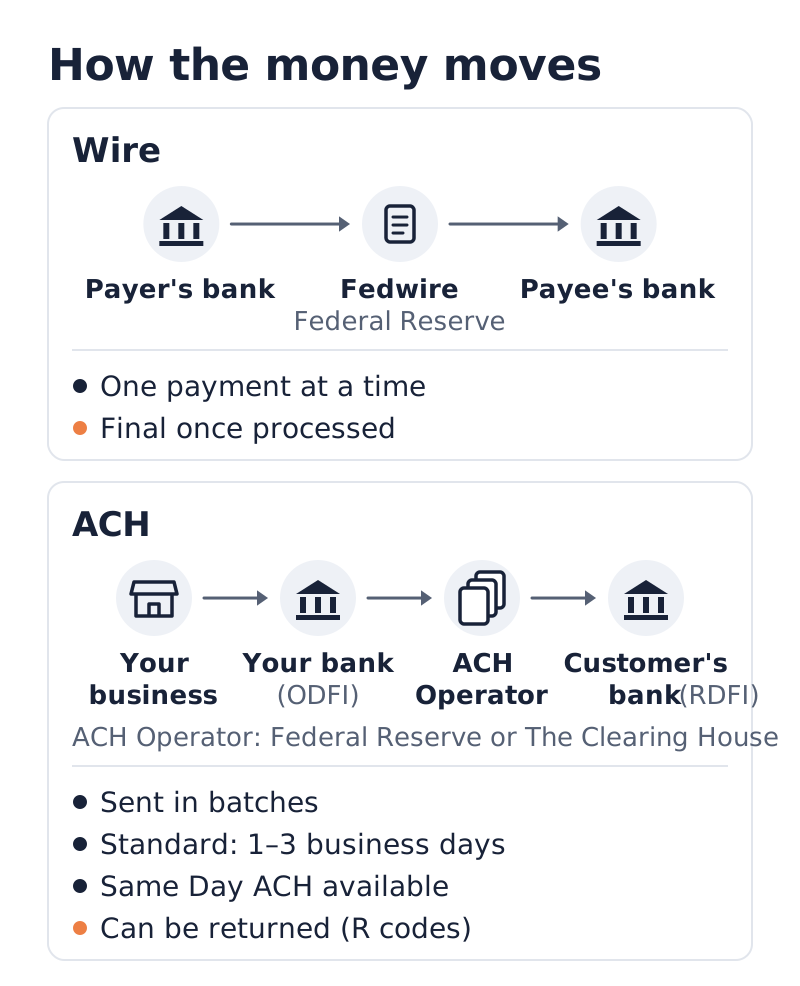
Wire transfers: one payment, settled on its own
The Federal Reserve Board describes Fedwire as a real-time gross settlement system. Each transfer settles individually, and the Board calls those transfers immediate, final and irrevocable once processed.
Fedwire keeps business-day hours. The funds-transfer day opens at 9:00 p.m. ET on the preceding calendar day and closes at 7:00 p.m. ET, with a 6:45 p.m. ET cutoff for customer transfers. It is closed on Saturdays, Sundays and Federal Reserve holidays. The Fed has announced plans to open Sunday through Friday, including weekday holidays, but no earlier than 2028. Your own bank sets an earlier cutoff for your wire requests, so ask what it is.
The law is different too. Wires fall under Article 4A of the Uniform Commercial Code, where a cancellation works only if the bank receives it in time to act before accepting the payment order. After acceptance, cancellation generally isn't effective unless the receiving bank agrees or a funds-transfer system rule allows it. Regulation E, the federal rule for consumer electronic fund transfers, expressly excludes transfers through Fedwire or a similar wire system used mainly between financial institutions or between businesses. Once a business wire leaves, getting it back depends on speed and cooperation. No rule entitles you to it.
ACH: batched, rules-driven and two-way
ACH (Automated Clearing House) is a network. Your bank or processor submits payments in batches, and the two ACH Operators, the Federal Reserve and The Clearing House, exchange them under rules set by Nacha, which governs the ACH Network.
ACH works in both directions. An ACH credit is pushed by the payer, as with payroll direct deposit or a customer paying your invoice. An ACH debit is pulled by the payee with the payer's authorization: rent drafts, membership dues, the eCheck. That pull is what makes ACH so useful for recurring billing and subscription payments. It is also where most of the return risk lives.
Nacha reports 35.2 billion ACH payments worth $93 trillion in 2025, including close to 8.1 billion business-to-business payments, up almost 10% over 2024.
Standard ACH typically settles in one to three business days. Same Day ACH is the faster lane. On the Federal Reserve's FedACH schedule, same-day entries have submission deadlines of 10:30 a.m., 2:45 p.m. and 4:45 p.m. ET, and they settle at 1:00, 5:00 and 6:00 p.m. ET the same day. Those are the banks' deadlines; yours come from your bank or processor. Same Day ACH has carried a $1 million per-payment limit since March 18, 2022, and Nacha's membership has approved raising it to $10 million effective September 17, 2027.
ACH vs Wire Transfer Speed: Settled Is Not Final
Once Fedwire processes a wire, the money is final, which is what a closing needs. The delays come from your bank's cutoff time and from weekends and Federal Reserve holidays.
Example: a wire that misses Friday. A buyer asks their bank to send a closing wire late on Friday, October 9, 2026, after the bank's wire cutoff. Saturday and Sunday are out. Monday, October 12, is Columbus Day, a Federal Reserve holiday in 2026. The next funds-transfer business day is Tuesday, October 13. A closing set for Monday morning won't have its funds. To avoid it, put the bank's cutoff on the closing checklist, and have the buyer send the wire a business day early.
ACH has the opposite problem. Same Day ACH can land the same afternoon, but a debit can still be returned after it settles. So treat "settled" and "final" as separate events, and don't ship a large order on an ACH debit the day it clears.
Wire Transfer vs ACH Transfer Fees
Neither rail charges the uncapped percentage that cards do, so both beat cards on large tickets. What differs is the fee's size and who pays it.
Wires are priced per transfer by each bank. There is no single "wire fee," so check your bank's published fee schedule for sending and receiving one. Your customer's bank sets its own sending fee. ACH through a processor is typically a flat fee per transfer, commonly somewhere between a quarter and a dollar, or a small percentage with a hard dollar cap. Same Day ACH costs extra.
Example: one $40,000 closing versus forty $1,000 invoices. Both move $40,000. The ACH column uses the quarter-to-a-dollar range.
| Scenario | Wire | ACH | Card |
| One $40,000 payment | One bank wire fee | $0.25 to $1.00 in total | $400 for every 1% of card cost |
| Forty $1,000 invoices | Forty bank wire fees, one per invoice | $10 to $40 in total | $400 for every 1% of card cost |
On the closing, one wire fee is small next to the certainty you're buying. ACH is cheaper, but that debit could come back after you've handed over the keys. On forty invoices, a wire fee on every one makes no sense, and ACH at $10 to $40 all-in is the obvious fit. Our ACH payment processing page runs the comparison against card fees.
Reversibility and Fraud Risk: Wire vs ACH
Wires: final until it goes to the wrong account
Finality is the reason to ask for a wire, and it's also the risk when you send one. A wire you receive can't bounce a week later. A wire you send to the wrong account has no return code to bring it back, only a recall request that the receiving bank may or may not be able to honor.
Business email compromise (BEC) is built on that gap. The FBI's Internet Crime Complaint Center (IC3) describes BEC as a scam targeting businesses that work with suppliers or regularly perform wire transfer payments, carried out by compromising email accounts and other communication channels. IC3's 2025 annual report recorded 24,768 BEC complaints and $3,046,598,558 in reported losses, second only to investment fraud among cyber-enabled fraud types by loss. In IC3's breakdown of how BEC victims reported losing money, wire transfer/ACH accounted for 86%. The usual version is a "vendor" or title company email with new wire instructions that lead to the criminal's account.
Acting fast is what gives you a chance to get the money back. In 2025, IC3's Recovery Asset Team started its Financial Fraud Kill Chain process on 3,900 incidents and froze $679,013,183, a 58% success rate. If a wire goes to the wrong place, do this the same day:
- Call your bank right away and ask it to request a recall of the funds.
- File a complaint at ic3.gov, whatever the amount. Both steps are the FBI's guidance.
- Stop every other payment to that payee until you've confirmed their bank details by phone, on a number you already had on file.
- Give your bank the email that carried the bad instructions.
ACH: returns are the risk you manage
An ACH debit can be returned for insufficient funds, a closed account or an unauthorized claim, usually within a few business days. Consumer claims that a debit was unauthorized or didn't match its authorization get a longer window: under Nacha rules, the return timeframe for those claims is 60 days. Our guide to ACH return codes explains each code and what to do about it. A properly worded ACH authorization form is your first line of defense.
Controls that work on both rails
- Never act on changed bank details received by email. Call the vendor or customer back on a number you already have on file, not one in the email.
- Tell customers in writing that your payment instructions will never change by email. Put it on every invoice.
- Require two people to approve outgoing wires and any new or changed vendor bank account.
- Validate bank accounts before the first ACH debit, and keep a signed authorization on file for every customer you debit.
Our small business fraud prevention guide covers more of these habits.
When to Ask for a Wire vs ACH
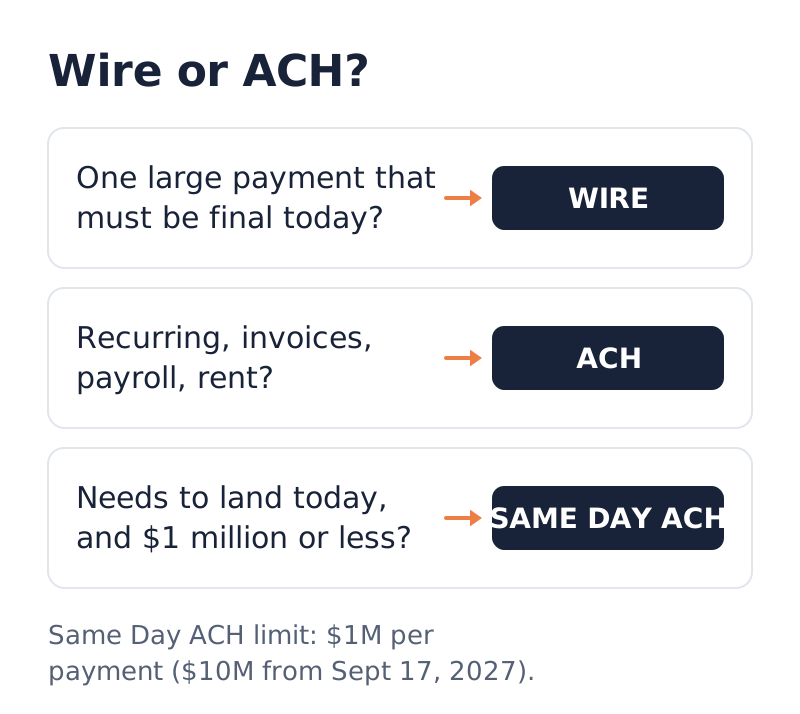
When you're getting paid, ask yourself whether this money must be irrevocable before you hand something over.
- Ask for a wire when one large payment must be final before you act: a real estate closing, a deposit on a large equipment sale, or a new customer's first big order that you won't release until the money is irrevocably yours.
- Use ACH for anything recurring or invoice-driven: monthly rent in property management, membership dues at gyms, retainers and payment plans at law firms, progress billing for contractors, and net-30 B2B invoices.
- Consider Same Day ACH when timing matters on a payment of up to $1 million but a wire isn't worth the fee.
Paying out follows the same logic. Payroll belongs on ACH direct deposit. Scheduled vendor payments go by ACH credit, and a wire makes sense only when a vendor truly needs same-day final funds.
Where eCheck and ACH Acceptance Fit for Merchants
Receiving a wire and accepting ACH are different jobs. With a wire, your customer does the work at their bank while you wait. With ACH acceptance through a processor, you control the timing: send an invoice or payment link, get the customer's authorization once, and pull payments on schedule. That is the model on our eCheck payment processing page.
Invoice-heavy businesses usually use all three: ACH for large invoices and recurring billing, cards for customers who prefer them, and wires for the rare payment that must be final today. Our B2B payment processing page covers how ACH and commercial card acceptance split that work, and our guide to how B2B payments work goes deeper into interchange and Level 2/3 data. Payment USA quotes ACH pricing next to card pricing, with the fee structure in writing before you sign.
What About Instant Payments?
Two instant rails now run bank-to-bank payments outside Fedwire hours. FedNow, the Federal Reserve's instant payment service, went live on July 20, 2023, and runs any time of day, on any day of the year. Its network limit for customer credit transfers rose to $10 million on November 12, 2025, though participating banks may set lower limits.
The RTP network, run by The Clearing House, has processed payments since 2017. It runs 24/7/365, supports transactions up to $10 million, and describes its settlement as final.
Availability and limits depend on both banks, so ask before you build a process around either one.
ACH vs Wire Transfer: Which Should Be Your Default?
A wire gives you one payment that is final once processed, for a fee your bank sets. ACH costs less per payment and handles recurring billing well, but you have to manage return risk. Make ACH your default and save wires for the few payments that must be final today.
If you're still collecting large invoices by card, the percentage you pay on every dollar is the number ACH is competing against. Send us a recent statement for a free statement review and we'll show you what those payments cost today and what they'd cost on the right rail.
This article is general information, not legal or financial advice. Payment rules, limits and bank policies change, so confirm the details with your bank or processor.
Sources
- Federal Reserve Board: Fedwire Funds Services, observed September 2026
- Federal Reserve Financial Services: Fedwire Funds Service Operating Hours, observed September 2026
- Federal Reserve Board: Press release on expanding Fedwire Funds Service operating hours (October 9, 2025), observed September 2026
- Federal Reserve Financial Services: Federal Reserve System Holiday Schedule, observed September 2026
- Uniform Commercial Code 4A-102, Subject Matter (Cornell LII), observed September 2026
- Uniform Commercial Code 4A-211, Cancellation and Amendment of Payment Order (Cornell LII), observed September 2026
- 12 CFR 1005.3, Coverage (Regulation E), eCFR, observed September 2026
- Nacha: Same Day ACH and Business-to-Business Payments Propel ACH Network Volume Growth in 2025, observed September 2026
- Nacha: Same Day ACH Expansion to $1 Million Begins Today, observed September 2026
- Nacha: Same Day ACH Per Payment Limit to Increase to $10 Million, observed September 2026
- Nacha: Differentiating Unauthorized Return Reasons, observed September 2026
- Federal Reserve Financial Services: FedACH Same Day ACH Processing Schedule, observed September 2026
- FBI Internet Crime Complaint Center: 2025 IC3 Annual Report, observed September 2026
- Federal Reserve Board: FedNow Service is now live (July 20, 2023), observed September 2026
- Federal Reserve Financial Services: FedNow customer credit transfer network limit increase, observed September 2026
- The Clearing House: RTP Network, observed September 2026
Frequently Asked Questions
What is the difference between ACH and wire transfer?
A wire transfer moves one payment at a time between banks and is final once processed. ACH moves payments in batches through a shared network under Nacha rules, costs much less per payment, and ACH debits can be returned after they settle. Businesses typically use wires for large one-off payments that must be final today and ACH for payroll, recurring billing and invoices.
Is a wire transfer faster than ACH?
Usually, yes. A Fedwire transfer settles individually and is final once processed, as long as it's sent during Fedwire hours on a business day. Standard ACH typically settles in one to three business days. Same Day ACH closes most of the gap for payments up to $1 million, with same-day settlement at 1:00, 5:00 and 6:00 p.m. ET on the Federal Reserve's FedACH schedule.
Can a wire transfer be reversed?
Not as a matter of right. The Federal Reserve describes Fedwire transfers as final and irrevocable once processed, and under UCC Article 4A a cancellation generally has to reach the bank before it accepts the payment order. After a wire goes out, your bank can request a recall, but the money comes back only if it's still there and the receiving bank cooperates. If you've been defrauded, the FBI advises contacting your bank immediately and filing a complaint at ic3.gov.
Can an ACH payment be reversed or returned?
Yes. An ACH debit can be returned for insufficient funds, a closed account or an unauthorized claim, usually within a few business days. Consumer claims that a debit was unauthorized or didn't match its authorization have a 60-day return timeframe under Nacha rules. That's why businesses that pull ACH debits should keep signed authorizations on file and validate accounts before the first debit.
Should I ask customers to pay invoices by wire or ACH?
For recurring or routine invoices, use ACH. It costs far less per payment and can be scheduled or pulled automatically with the customer's authorization. Ask for a wire when a single large payment has to be final before you act, such as a closing or a deposit before you release goods. Either way, tell customers in writing that your payment instructions will never change by email.
About Payment USA’s Founder
Published by Payment USA, a merchant services provider. Our guides and comparisons reflect that commercial perspective.

Chase James
CEO, Payment USA
Chase James is the founder and CEO of Payment USA, a merchant services company built on transparency and fair pricing. With over 15 years in the payments industry, Chase has helped thousands of businesses uncover hidden processing fees and switch to honest, interchange-plus pricing.
Contact Chase →